The guqin is a fretless zither whose seven strings are made of twisted silk. Its upper board is traditionally made of wutong wood and its lower board of zi wood, and thirteen studs (hui) mark the finger positions. It is widely described as the most prestigious instrument in China, closely associated with scholars and with intimate, private settings rather than public performance.
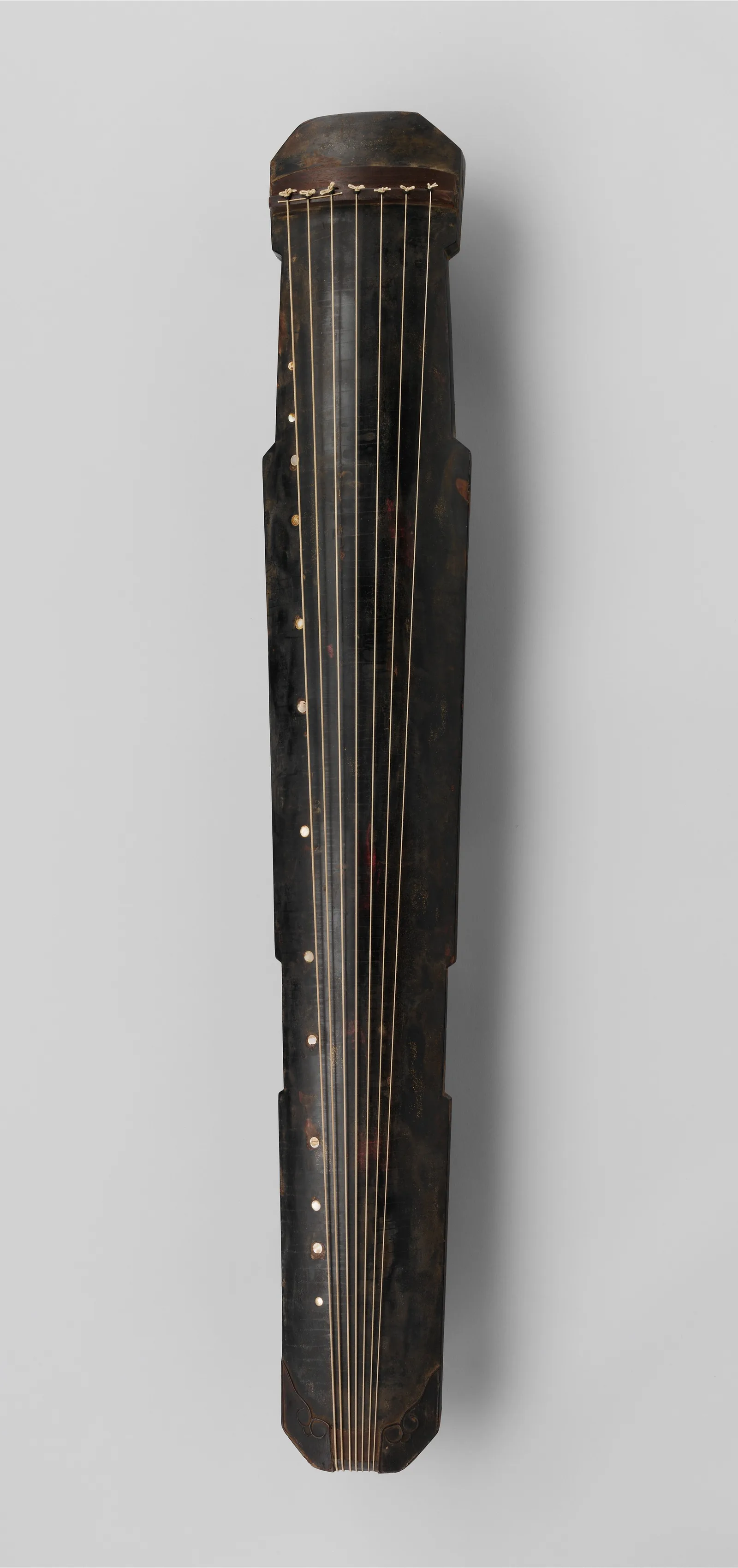
instrument
Guqin
古琴
A seven-stringed Chinese zither, plucked with the right hand while the left hand stops the strings or touches them to sound harmonics.
- Type
- instrument
- Instrument family
- Zither
- How sound is produced
- Plucked
- Also known as
- qin, seven-string zither, 七弦琴
- Updated
- 2026-10-13
- plucked
- zither
- silk strings
Structure & Sound
Only what the cited sources document.- Strings
- Seven strings of varying thickness, made of twisted silk
- Structure
- A long wooden soundboard; the upper board of wutong wood, the lower board of zi wood, with 13 studs (hui) marking finger positions
- Sound
- Open strings give strong, clear sounds; harmonics produce a light, floating overtone
What vibrates, and how the strings are set up.
Body and construction.
Timbre and register, where a source describes them.
Playing Technique
What the player does, and the named techniques behind it.- Playing method
- The right hand plucks; the left hand stops the string, or touches it lightly for harmonics
What each hand does.
Named techniques
- Open-string notes (san) (散音)
Open-string notes are one of the three fundamental ways a guqin is sounded.
Notes produced on the guqin by plucking a string that the left hand does not stop, giving the instrument's deep, resonant low register.
- Stopped-string notes (an) (按音)
Stopped-string notes let the player change pitch and slide, since the guqin has no frets.
Notes produced when the left hand presses a guqin string down onto the soundboard, shortening the vibrating length and changing the pitch.
- Harmonics (fan yin) (泛音)
Harmonics are the third fundamental way of sounding the instrument, giving a clear, floating overtone.
Bell-like notes produced on the guqin by lightly touching a string at a nodal point while the right hand plucks it.
Where it is heard
Documented settings, ensembles and occasions.- Typical context
- Solo playing in intimate settings, associated with scholars rather than public performance
Where the instrument is normally heard.
Instrument family
How this site groups instrumentsPlucked String Instruments (弹拨乐器)
This site groups instruments by how their sound is produced — bowed, plucked, blown or struck. Guqin is a plucked string instrument.
Also in this family
Related instruments
- Guzheng (古筝)
Both are Chinese zithers and are frequently compared; the zheng uses metal strings tuned with pegs on the top board, while the qin uses strings of twisted silk.
A long plucked Chinese zither with metal strings tuned by pegs on the top board, used for home entertainment, folk music and court ensembles.
Compare these instruments side by side →
History & Culture
- Literati Qin Culture (文人琴文化)
The guqin is closely associated with the practice and values of Chinese scholars.
The association of the guqin with Chinese scholars, poetry and self-cultivation, developed over centuries.
Reading about Guqin
Longer pieces on this siteSources for Guqin
UNESCO Intangible Cultural Heritage · cultural heritage
Supports:
- The guqin as a Chinese zither with a tradition of over 3,000 years
- Seven strings and thirteen marked pitch positions
- The three basic playing techniques: san (open string), an (stopped string) and fan (harmonics), and how each is produced
- The guqin's development as an elite art practised by scholars in intimate settings, not for public performance
- Inscription on the Representative List of the Intangible Cultural Heritage of Humanity (2008, originally proclaimed 2003)
The Metropolitan Museum of Art · museum
Supports:
- The guqin's prestige as one of the most highly regarded instruments in China
- Construction: upper board of wutong wood, lower board of zi wood, 13 studs (hui) marking finger positions
- Strings of varying thickness made of twisted silk
- Historical accounts of the qin in Han-dynasty writing and Ming-dynasty literati practice
- Museum classification: chordophone, plucked long zither
"Xiangpu's Treasure" Guqin (古琴)
The Metropolitan Museum of Art · museum
Supports:
- The physical form and materials of one surviving guqin (wutong wood, lacquer, mother-of-pearl, silk, jade)
- The date and dimensions of a specific historical instrument (mid 19th century)
Not yet documented for this entry: music theory. Nothing is added to an entry until a source supports it.